Heritage

Two hundred and fifty years of farming this same valley.

Greeneville and Greene County have a real, documented agricultural history, from Cherokee corn fields to a century of burley tobacco to the small, diversified farms growing here today. This is that story, and where ours fits into it.

Greene County before 1800

The old roads, rivers, settlements, and stories in one place.

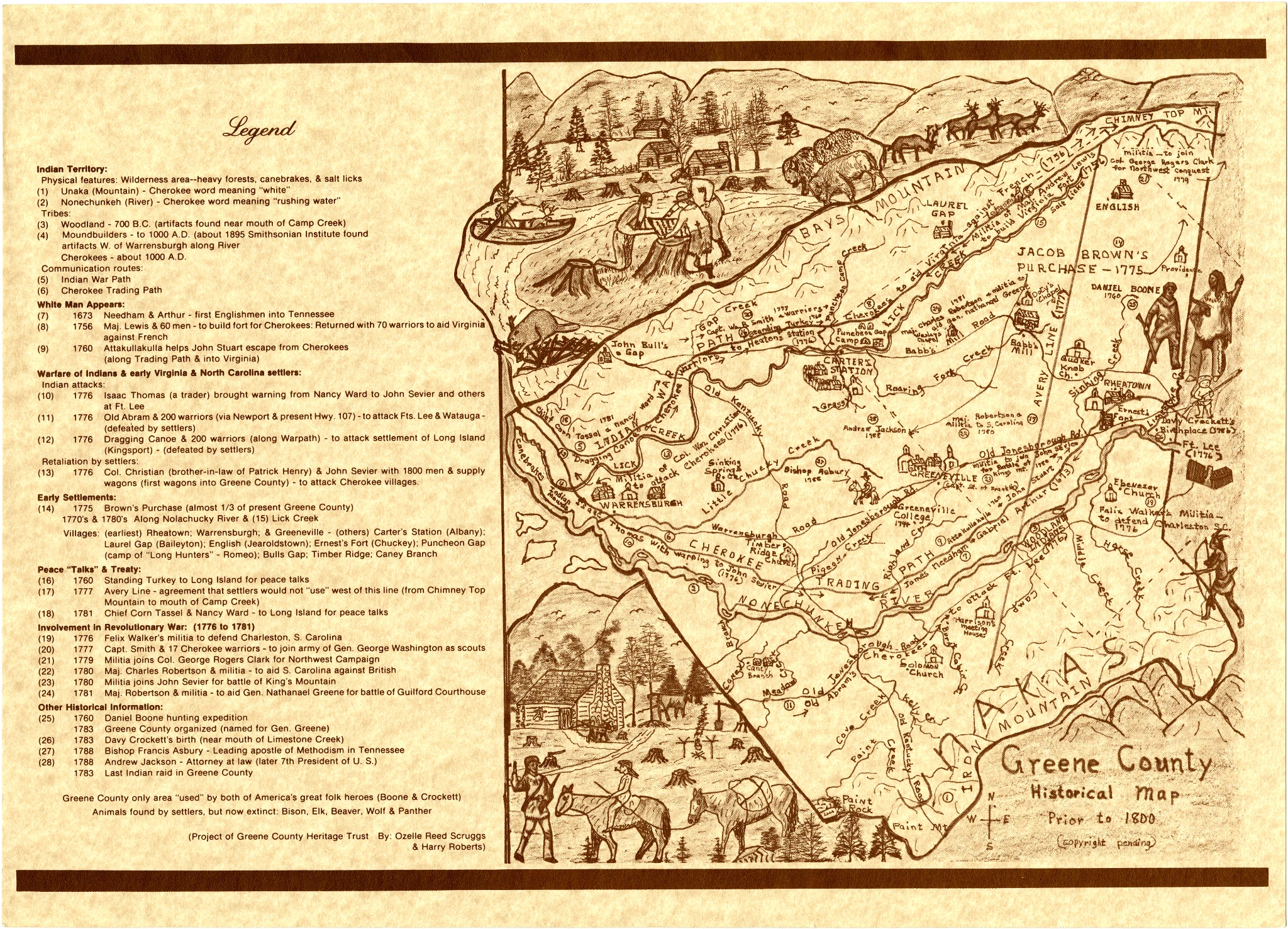
This historical map shows Cherokee routes and settlements, the Nolichucky River, Jacob Brown’s Purchase, early forts and stations, and mountain gaps. Use the reference pins to orient yourself, then open the full-resolution original when you want to read the handwritten labels closely.

Historical Greene County map with selectable reference points
Map reference

Nolichucky River

The map labels the river across the lower middle of the county and ties several early settlements and routes to it.

Open original full-size map ↗

Credit as printed on the map: Project of Greene County Heritage Trust · Ozelle Reed Scruggs & Harry Roberts.

The timeline

From Cherokee hunting ground to the 16th state.

Scroll through. Thirteen moments that shaped this county, in order.

Before 1775

Cherokee homeland

This valley between the Bays Mountains and the Nolichucky was Cherokee hunting ground, and had been home to Woodland-era and mound-building peoples for thousands of years before that. Corn, beans, and squash, the “three sisters,” were already being farmed here long before any settler arrived.

1775

Jacob Brown's Purchase

Jacob Brown negotiated a purchase of Cherokee land along the Nolichucky River, opening roughly a third of present-day Greene County to settlement, the first real wave of the farms that would follow.

1783

Greene County organized

Formed out of North Carolina and named for Gen. Nathanael Greene of Revolutionary War fame, under whom many local settlers had served.

1785–1788

Capital of the State of Franklin

Greeneville served as capital of the short-lived, breakaway State of Franklin, an attempt by settlers here to form their own state outside North Carolina's control. It fell just short of admission to the Union.

1786

Davy Crockett born

Frontiersman and folk hero David “Davy” Crockett was born in the Limestone community of eastern Greene County.

1794–1795

First college west of the Alleghenies

Greeneville College, founded by Hezekiah Balch, and Washington College, chartered under Samuel Doak, both trace to this decade. Their lineage continues today as Tusculum University.

1796

Tennessee becomes a state

Greene County's Overmountain settlers were there for it: Tennessee entered the Union as the 16th state, folding this valley's farms into a new state's economy.

1826–1875

Andrew Johnson's Greeneville

A runaway tailor's apprentice from North Carolina set up shop in Greeneville and made it his home for the rest of his life, eventually becoming the 17th President of the United States.

Mid-1800s

The railroad arrives

Rail lines reached East Tennessee, connecting local farms to markets beyond the mountains for the first time. Before this, most of what was grown here stayed here.

1885

Greeneville's tobacco market opens

A dedicated market for burley tobacco was established in Greeneville, and the town grew into one of the leading burley tobacco markets in the entire country.

1928

Pet Milk comes to town

A Pet Milk processing plant opened in Greeneville, and dairy farming grew into a major part of the local economy alongside tobacco for the rest of the century.

2004

The tobacco buyout

The federal Fair and Equitable Tobacco Reform Act ended more than 70 years of price supports and production quotas overnight, reshaping how, and whether, local farms grew tobacco at all.

Today

Small, diversified farms

A new generation of small farms, ours included, is growing fruit, vegetables, and seed and selling it directly to the people eating it, the same direct, hands-on relationship to the land this valley started with.
Cash Crops Through Time

What actually paid the bills here, era by era.

Farming in Greene County was never just one thing, but for a long stretch of the 20th century it was mostly one thing: tobacco. Here's the full arc, from subsistence crops to today.

01
Pre-1775

Corn, beans & squash

The “three sisters” were grown together by the Cherokee throughout this valley long before European contact, corn for structure, beans climbing it, squash shading the ground beneath.

02
1780s–1800s

Corn & driven livestock

Early settler farms grew corn for their own tables and stock, while cattle and hogs were driven on foot over mountain roads to markets in Virginia and the Carolinas. Almost nothing left the valley by wagon until the roads improved.

03
Early 1800s

Flax & wool

Alongside food crops, small farms grew flax and raised sheep for wool, spun and woven at home into the cloth that clothed a frontier household.

04
1885–2004

Burley tobacco

The defining cash crop of the region for well over a century. Greeneville's 1885 tobacco market grew the town into one of the nation's top burley markets, regulated for decades by federal quotas until the 2004 buyout ended the program nationwide.

05
1928 onward

Dairy

Pet Milk's 1928 plant in Greeneville turned dairy into a serious second income for local farms, a role it held well into the second half of the century.

06
20th century–today

Beef cattle & hay

Alongside tobacco and dairy, cattle and hay have stayed a steady, unglamorous constant in the county's farm economy, and remain some of Greene County's most valuable agricultural products today.

07
Today

Diversified, direct-to-market produce

Fruit, vegetables, herbs, and seed, grown on a small footprint and sold straight to local families instead of through a single commodity market. Where Price Family Farm fits into this same 250-year line.

Where we fit in

We’re not the first farm on this land, and we won’t be the last.

Burley tobacco built this county for a hundred years and then, almost overnight, stopped being the answer. What’s replaced it, here and on farms like ours across the county, is smaller, more varied, and sold directly to the people eating it. Read how we’re doing that today.